Saturday, October 9, 2010

Day 25: Our Last Day in San Francisco

We took our hearts with us but before we left San Francisco, we had a few more icons to visit.
The Golden Gate Bridge, resplendent in its orange coat, is a symbol by which San Francisco is recognized the world over in movies, on tv and in the minds of anyone who has stood at the south end and visually followed her curved structure, or walked, jogged, cycled or driven her 4,200 foot main span across San Francisco Bay. Her notoriety is not without technical merit, either. It is one of the longest suspension bridges ever built and the two distinctive towers are the world’s tallest bridge towers at 746 feet. But a testament to the bridge’s popularity is the number of tour buses and other tourists crowding into the viewing area – on a Friday – in October.
My minor disappoint in the Mission of San Luis Obispo had to be rectified. And so it was in the Mission of San Francisco de Asis, also known as Mission Dolores. Of the 21 California missions, Mission Dolores, one of the oldest buildings in San Francisco is, according to the volunteer in the gift shop, the only mission that remains as it was originally constructed in 1776. It was established by Father Junipero Serra as was San Luis Obispo and many of the other California missions.

A walk through the mission cemetery garden was at once beautiful and haunting. The gardens are simple but cared for (the gardeners, who are likely also volunteers, were on the grounds during our visit). Grave markers from the 1800’s include some notable citizens of the time, at least one family group and several children.


The Basilica adjacent to the mission is quite ornate by comparison to the mission’s austere white-washed adobe structure. The mission survived the 1906 earthquake but the basilica did not and was re-built.


Our escape from San Francisco was over the Bay Bridge. An engineer or architect or even an open-minded citizen might find some beauty somewhere in the design, perhaps in the mere fact that it’s a two level bridge, but, in my opinion, it’s one of the ugliest structures I’ve ever seen.
Until tomorrow. . . .

Day 24: Downtown San Francisco

The transit system in San Francisco is probably one of the best in the world. Of course, I haven’t been around the world to test them all, but I just can’t imagine there being a better system. Buses, electric trolleys, cable cars, street cars and the BART (Bay Area Rapid Transit) give commuters several route options and gets San Franciscans out of their cars. Yes, there is a rush hour but, for a city the size of San Francisco, it’s really not that bad. There are several different types of passes to suit everyone’s transportation needs.
Our primary objective today was downtown, specifically Market Street, even more specifically Ross, Dress for Less. So, we checked the route, hopped on the #30 and headed downtown. We got off the bus at Sts. Peter and Paul Catholic Church and on our own walking tour, saw most of the usual sights. We climbed up Telegraph Hill to the Coit Tower, named for Lillie Hitchcock Coit who bequeathed it to the city. The top of the 210-foot tower is narrower than the bottom and some say it resembles a fire hose nozzle. Lillie had an affection for firefighters and as a schoolgirl attended fires as a volunteer. The view from the top of the tower is supposed to be quite spectacular but even from the base the vista afforded views of the “crookedest street in the world”, Lombard Street, and Alcatraz.
Our tour also took us to the Transamerica Tower, which, other than the Golden Gate Bridge is probably the most recognizable structure in the city. It stands 810 feet, contains 48 stories and is covered with crushed quartz which gives it its white façade.


Old Saint Mary’s, California’s first cathedral, is an incongruous 150 year old brick building on the edge of Chinatown and in the midst of downtown skyscrapers. The original church building survived the 1906 earthquake only to be gutted by ensuing fires.


Our walk around downtown was intermittently punctuated by thundering roars from the sky. The reverberation off the tall buildings made it difficult to tell from what direction the sound was coming, but craning upwards at the right place at the right time, we would occasionally catch a glimpse of the Blue Angels overhead between the buildings - some singles and some flying five in formation. It was a beautiful sight. It seems there is a combination of celebrations this weekend: it’s the start of fleet week, the San Francisco (baseball) Giants are starting the playoffs at home and Monday is Columbus Day. Talk about the right place at the right time.
Until tomorrow. . . .

Wednesday, October 6, 2010

Day 23: Fisherman's Wharf

Joggers, walkers, cyclists and segwayers on the municipal pier and swimmers in the bay all added to the somewhat unexpected hub of activity around the Bay area harbor; unexpected considering it was mid week and mid October. Fisherman’s Wharf was alive with enthusiastic vendors of the ubiquitous wind jackets, fleeces, and hats and with the intoxicating aroma of fresh steamed mussels, clams and crabs. And, depending on the vantage, we were treated to views of Alcatraz or the Coit Tower or the Transamerica Building.

Walking was our activity for the day. It was a little over a mile from our motel on Lombard Street to Fisherman’s Wharf and several more miles to visit every shop on the wharf in the hope of finding the perfect hat or jacket or other memento.
We did a lot of research to seek out the best eatery for our lunch, stopping by many sit-down restaurants to check their menus and most of the kiosks that offered clam chowder in bread bowls, crab, shrimp and tuna cocktails and of course fish and chips. We settled on Cioppino’s which was actually the first restaurant whose menu we reviewed and whose cioppino was claimed to be the best in San Francisco according to some food magazine.  For those who aren’t familiar with cioppino, it’s a chunky mélange of seafood usually including some sort of white fish, prawns, mussels, clams, and calamari in a rich, spicy tomato sauce. It’s not sure whether it wants to be a soup or a stew. But it’s one of my favourite seafood dishes. And Cioppino’s didn’t disappoint. Once we determined that the cioppino was gluten-free we shared a large bowl on the sunny patio and capped it off with a cappuccino. Cioppino and Cappucino on the patio on Fisherman’s Wharf. Perfect.
Nourished and refreshed by our most relaxing and enjoyable lunch, we were able to negotiate the crowds on Pier 39, a shopping mecca to behold. Shop after shop and café after café wind along both sides of the pier on two levels with the central attraction being a two level carousal.
My own shopping experience today was a lesson in price bargaining. Although, I have to admit I contributed very little to the price reduction other than to remain silent. I had dropped into a camera shop to ask about a lens hood, something I’ve been thinking about for awhile. I purchased one and immediately the salesman presented me with a polarizing filter – a new HD version of one I have at home. The effects of the sample exposures using my own camera were astounding but the price was steep at $129. My hesitation, however, brought the price down by increments to $59. I’m embarrassed to say that the whole process was so overwhelming that I didn’t buy the filter but rather decided to sleep on it. I’ve been having what is probably the opposite of buyer’s remorse ever since.
Our walk back to our motel took us through heaven: Ghirardelli Square, chocolate central. Ghirardelli chocolates are available most places now but the 1895 red brick building in the centre of San Francisco is where it all started.
It was a cold, windy walk back to our motel. My feet hurt but it was a good day.
Until tomorrow. . . .

Tuesday, October 5, 2010

Day 22: The Road to San Francisco

The drive to San Francisco took us through acres and acres of farmland. Whenever we drive through this countryside here, I am amazed not only at how expansive the farmland is but how organized. Row upon row in field upon field of whatever vegetable or fruit is farmed in the area is laid out in exactly symmetrical lines. Farm vehicles and pickup trucks line the edges of the field and dozens of laborers bend over their work. I barley know an artichoke when I see it in the grocery store but today I saw thousands of them on their squat bushes, their spiny pineapple-shaped heads balancing on the ends of their stalks. In several areas there were signs advertising “French Fried Artichokes”. We didn’t actually see anyone selling them, but, if it’s not actually a myth, I’d like to try them if I come across them again.
In another farm area, flat topped two foot wide furrows were tightly wrapped with plastic. Passing through the farmland, the furrows were progressively further along in their growing cycle. In the next area, the furrows were covered with strawberry plants that had poked through the plastic and in the next, the strawberries were being harvested. When a fruit stand popped up a little way down the road, it seemed fitting that we stop and enjoy the fruits of the area.
A sign on the highway directed us to the Swanton Farm, a U-pick farm that we almost passed by since we didn’t really have time to go berry picking. When we entered the farm building that was set back on the property, there was no proprietor to assist us. In fact, there was no one in the rather spacious, eclectically decorated barnlike building except a man putting money in a tray. It turned out to be the epitome of an honour system. If you were there to pick berries, there were boxes available to take to the field, return with the berries, weigh and pay. There were half a dozen open jars of homemade jam for the tasting, with animal crackers to spread them on, baskets of picked strawberries and various other goods to purchase. Prices were clearly marked. We sampled a couple of the jams on plastic spoons (also provided), selected a basket of strawberries, put our money in the tray that, incidentally, had a considerable amount of money already in it, and left without ever seeing an owner or worker. And the strawberries were delicious! Best I’ve had in a long time.
We took the coast highway all the way to San Francisco. The coast is rugged with black rock both contrasting and complementing the light sandstone cliffs. Blue and white surf crashes against the shore and a voracious low growing succulent spreads over the dunes and adds its fall red to the colour palette. A lighthouse on any coastline is an icon. But, the 138 year old, 115 foot Pigeon Point Light Station near Pescadero, is one of the tallest in the US and fit perfectly into this misty, coastal landscape.

Until tomorrow. . . .


Days 20 and 21 - San Luis Obispo and Monterey

Day 20 –San Luis Obispo and the road to Monterey
I always feel somewhat privileged to arrive in a location at a time when I can attend Mass at a historically significant sight. It happened in Portugal when I arrived at the Basilica at Fatima just as Mass was starting. And, I was at San Luis Obispo, California (SLO) for Sunday Mass at the famous 18th century Mission San Luis Obispo de Tolosa church. The plan was to attend Mass and then join a guided tour of the mission. At the last minute, however, the tour guide was unable to make it and there was no tour. I spent some time walking around the peaceful gardens in the mission courtyard and visiting the on-site museum. It contained a collection of artifacts from the period but little to describe the history of the mission or even to indicate that these items or even the buildings were authentically part of the original mission.
Historically, in a nutshell, the SLO Mission was part of a chain of missions established by Spain starting in the 1700’s to build their territories in the new world. SLO was established by Franciscan Father Junipero Serro in 1772 and was named after St. Louis, Bishop of Toulouse, France. It has functioned as a parish church since the second half of the 19th century.
Although, the mission itself was a bit disappointing, the acoustics in the church were great, the soprano’s voice was excellent, and they had a large gift shop that is open 7 days a week from 9 to 5.
Back on the road again, we stopped near San Simeon, probably best known for Hearst Castle, the 165 room, 3 guest house, 127 acre former estate of publishing magnate William Randall Hearst perched high on Cuesta Encantada (Enchanted Hill) overlooking the town. We saw the “castle” from the highway but didn’t take the usual tour that most tourists passing through the area wouldn’t miss. Instead we were treated to the beautiful vista that was Moonstone Beach and one other spectacle that this tourist wouldn’t have missed: hundreds of elephant seals sunning themselves on the beach. There was the occasional flip of sand, a sudden burst of song, and the entertaining neck dance which is called sparring and is nature’s way of strengthen their neck muscles so as adults, they can fight off the other males to win the female. But most of them were just lying there, resting, preparing for their long sea migration. I felt I was intruding on a private moment when one seal raised her head and looked in my direction. Her partner lying next to her raised his flipper and gently pushed her back down beside him. His flipper reminded draped across her. There, there, dear.
The rest of the drive was along a winding road that climbed high along the side of the mountain and then fell again toward the sea, then again up the side of the mountain. Intermittent construction delays enabled us to enjoy the ocean vistas and the pampas grass that sprung up in the mountain crevices in some areas and covered the mountain sides in others.
The temperature had dropped significantly by the time we reach Monterey, so the perfect end to a perfect day was the fireplace at the foot of our king sized bed.
Day 21 – Monterey Peninsula

Our tour of Monterey started with a walk around Cannery Row a former hub of sardine canneries of the early twentieth century and now a collection shops, galleries, eateries, and inns. Cannery Row was probably put on the map by John Steinbeck’s novel of the same name.
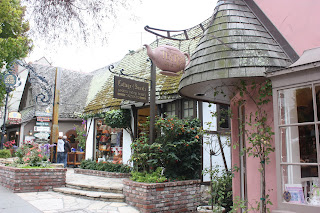
We then embarked on the “17 Mile Drive”, a self-guided road trip around the Monterey Peninsula which took us past 14 golf courses, including Pebble Beach, home of the US Open, picturesque overlooks that featured the huge Monterey Cypress trees and the Ghost Tree and delivered us to Carmel-by-the-Sea. Carmel is a very quaint, European influenced town with unique gift shops and galleries, and high end restaurants and coffee shops. If you’re looking for the typical souvenir shop in Carmel, it’s probably tucked away on a side street not really wanting to be discovered. Like small old town Europe, there is very little parking and the street signs are subtle posts on the corner near the buildings. Unique plant combinations of succulents and florals in the many border gardens add fragrance and colour to the fairytale ambience.
The temperature is even colder tonight than it was last night, around 60F. Considering that most of our trip so far has been over 90 and many days over 100, it’s a bit of a shock to be more than 30 degrees below our average. San Francisco should be slightly warmer.
Until tomorrow. . . .


Sunday, October 3, 2010

Santa Barbara is a beautiful city with all the charm of some of the towns we visited in Spain. Not having been to Mexico and knowing little about the history and architecture of that country, it’s possible that the style of the town that I am identifying with Spain is, in fact, Mexican. But the stucco walls, red tiled roofs, and signature wrought iron upper story railings were reminiscent of the Spanish towns we visited in Andalucía. Even the red and pink blooms that climb up trellises and fall over rock walls in Santa Barbara were prolific in Spain.
State Street, the main downtown strip was a long stretch of open door shops and outdoor cafes. Side alleys held their own hidden treasures and opened into courtyards or open air shopping malls like consumer secret gardens. Even the pedestrian walkways were patterned with different coloured bricks as they were in Europe.
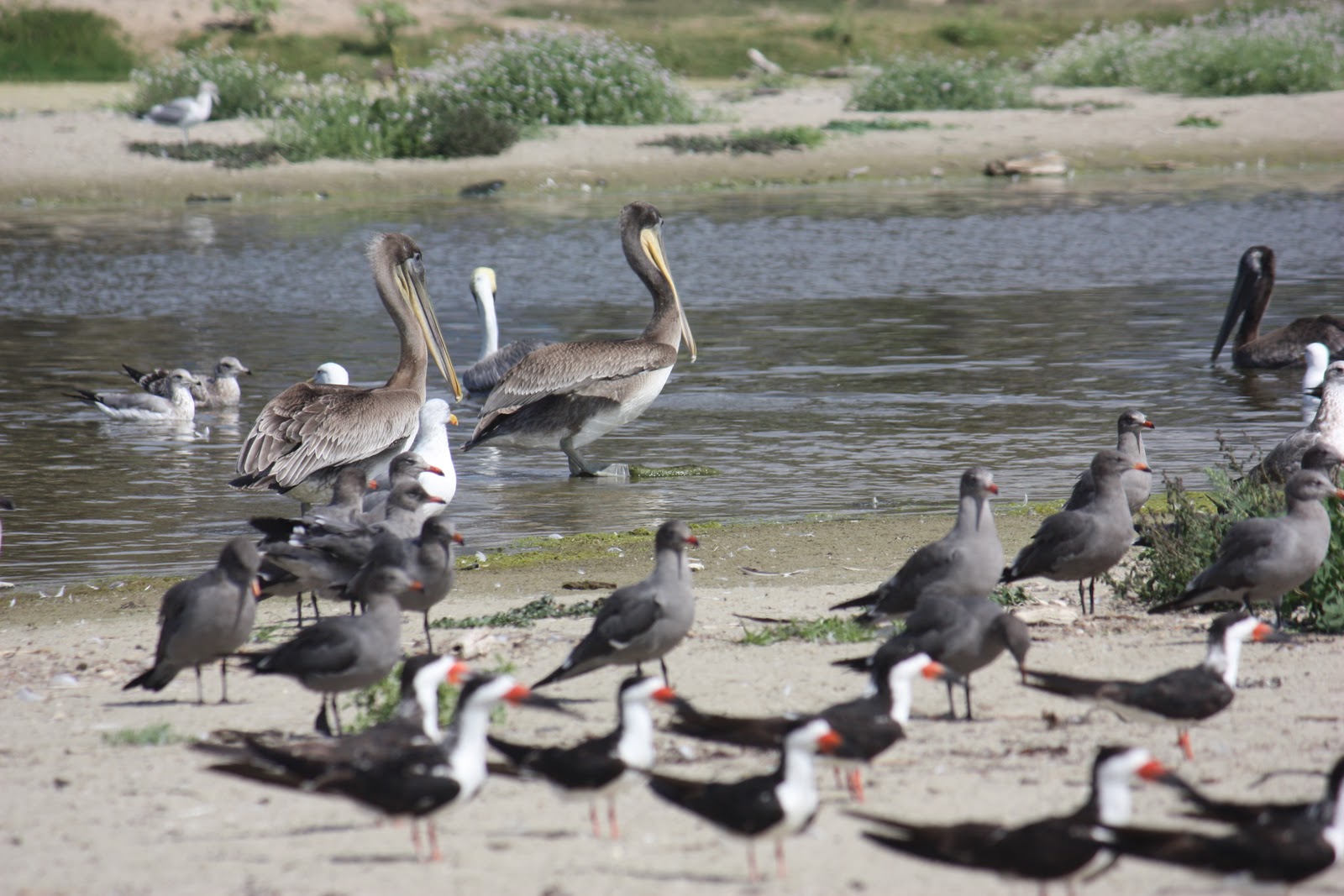
Santa Barbara is a city I could return to. (Sorry about the dangling preposition). Beautiful parks, European architecture and culture, near perfect climate, and – pelicans (and other birds). Who wouldn’t want to come back?


Our route to San Luis Obispo was the coast highway, the road less travelled. For the most part it was a slower freeway that would end as we reached a town and then begin again as we left it. Just south of Guatalupe, in an obviously agricultural area, there were fields upon fields of blue/green foliage in perfect rows and a smell of cabbage permeatd the air. I was thinking broccoli or cauliflower, but I couldn’t see any crowns on the plants.  This will remain a mystery for the time being.
Until tomorrow. . . .

Saturday, October 2, 2010

Day 17 and 18: Universal Studios and the road to Santa Barbara

Day 17: Universal Studios
I was once told that a visit to Universal Studios would take the glamour out of the movies. Perhaps it’s because the presentation format has changed at Universal, but there were few secrets divulged and consequently few bubbles burst in terms of how all the magic happens.  Instead, we were thrown front and centre into the action. On our backlot tour, we were attacked by dinosaurs who thundered through the jungle and knocked our tram car about, hissed at us and showered us with their moist breath until we were rescued by King Kong who loomed enormous beside us and then thumped across the top of our car to annihilate T-Rex; our tram stalled on a bridge over a dry riverbed somewhere in the old southwest when suddenly, a flashflood put us in danger of being washed away. The water rushed down the riverbed toward us but took a sharp turn as it reached the bridge and flowed off through the nearby viaducts; we stopped unexpectedly in a subway tunnel. As happens frequently in Los Angeles, the ground began to shake and the walls heave. It was the big one! A subway car careening through the tunnel jumped its track and jackknifed sliding sideways toward us. It came to rest against a support pillar again keeping us from harm’s way but the ceiling then caved in and a vehicle from the street above slid into the tunnel. As suddenly as it had started the shaking stopped and we were able to leave the tunnel unscathed.  And, I’m not even going to tell you, although I’m sure you’ve heard, what happened when we went to Amity Island.
A live action performance of Waterworld demonstrated some astounding stunt and pyrotechnic techniques that had stunt actors falling meters into the water, spinning refitted Sea-doos around the lagoon, nosing them underwater, and flying them through grenade blasts. At the peak of the excitement a battered twin prop flew over the wall through a curtain of fire, landed in the lagoon and came to rest right in front of the first row of spectators. As amazing as all these scenes were, the most incredulous thing about them was the fact that they were being performed live. No re-takes, no out-takes, no post-production. No matter what happened on that set, there was no going back. That’s what kept me on the edge of my seat.
Then there was – The Simpsons - the roller coaster ride from hell. As your coaster clicks upward, Sideshow Bob destroys the roller coaster one section at a time. You careen down the steepest hills and bank around sharp turns when suddenly your car is in mid air because there is no more track beneath you, Then, you come crashing back down onto a still-standing part of the coaster and you are turned upside down as the structure is ripped out from under you. The technically cleaver thing about this attraction is that your car never really goes anywhere. Except for shaking and tipping and tilting of your seat, it’s all visual. There is no actual forward movement of your car along a track as in a real roller coaster. But that didn’t belay the stomach wrenching sensations of dropping hundreds of feet. It might have been a cartoon, but it’s a ride I won’t soon forget.
Taking the Grayline tour bus to and from Universal was well worth the $80 charge. Besides the Fantastic experience at the park, we had the opportunity to witness but not actually have to drive in Los Angeles freeway traffic.
Day 18: The drive to Santa Barbara

Redondo Beach Pier

From Anaheim, we headed for Redondo Beach by an inland route that took us through some less attractive parts of Los Angeles including the BP Refinery which was for lack of another term: ugly. From Redondo, we went north along the Pacific Coast Highway through one beach town after another. These beach areas had eclectic collections of building styles and were studded with sudden outcroppings of large power plants or oil and gas refineries.
But, the most colourful beach town was Venice Beach. Venice is not just a beach community with the usual half-clad surfers and bathers but also a blend of cultures from African American musicians hawking their home made CDs, to skaters trudging down the boardwalk with their pants literally below their butts, to break dancers and acrobats, to the hucksters of “medicinal Kush”.
We passed through many other beach areas including Malibu. However, with no sightings of Charlie, we decided to move on. At first dusky glance of Santa Barbara, it appears to be a very pretty, quaint city. I’m looking forward to seeing more of it tomorrow in daylight.
Until tomorrow. . . .